
One health record you own.
AI that can reason over it safely — instead of a dozen apps that each hold a fragment.
One health record you own.
AI that can reason over it safely — instead of a dozen apps that each hold a fragment.
Health software is built around fragments.
Twelve streams of your life, held by a dozen different apps. None of them hold you.












The Longitudinal Health Profile is the durable object.
Health Core takes every event in with source and time. Provenance, continuity, uncertainty, and agency are properties of the record itself — not of any one app.
Provenance
Every data point shows its source.
Continuity
Nothing gets dropped over time.
Uncertainty
Guesses stay labelled as guesses.
Agency
Change or delete any of it.
What the record actually looks like.
Every entry keeps its source and confidence. Agents reason across entries instead of guessing in isolation.
Sleep below baseline
Wearable
Mar 12
High
New medication started
You logged
Mar 14
Confirmed
Resting heart rate rising
Wearable
Mar 18
Medium
Illustrative sample data — not a real profile or medical advice.
The same profile, three ways out.
Frontier models via MCP, the personal app, clinician-ready context — each inherits the same consent model.
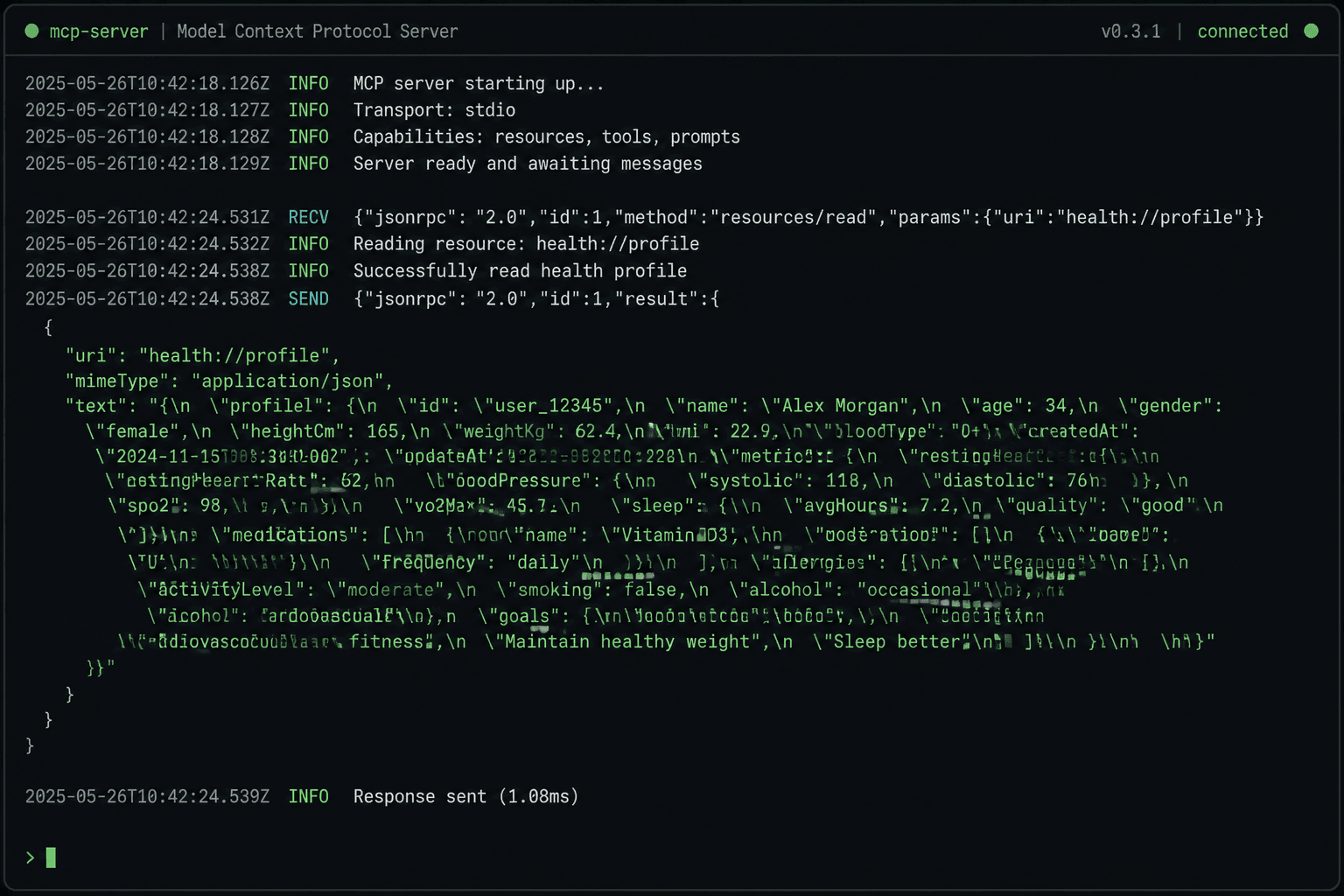
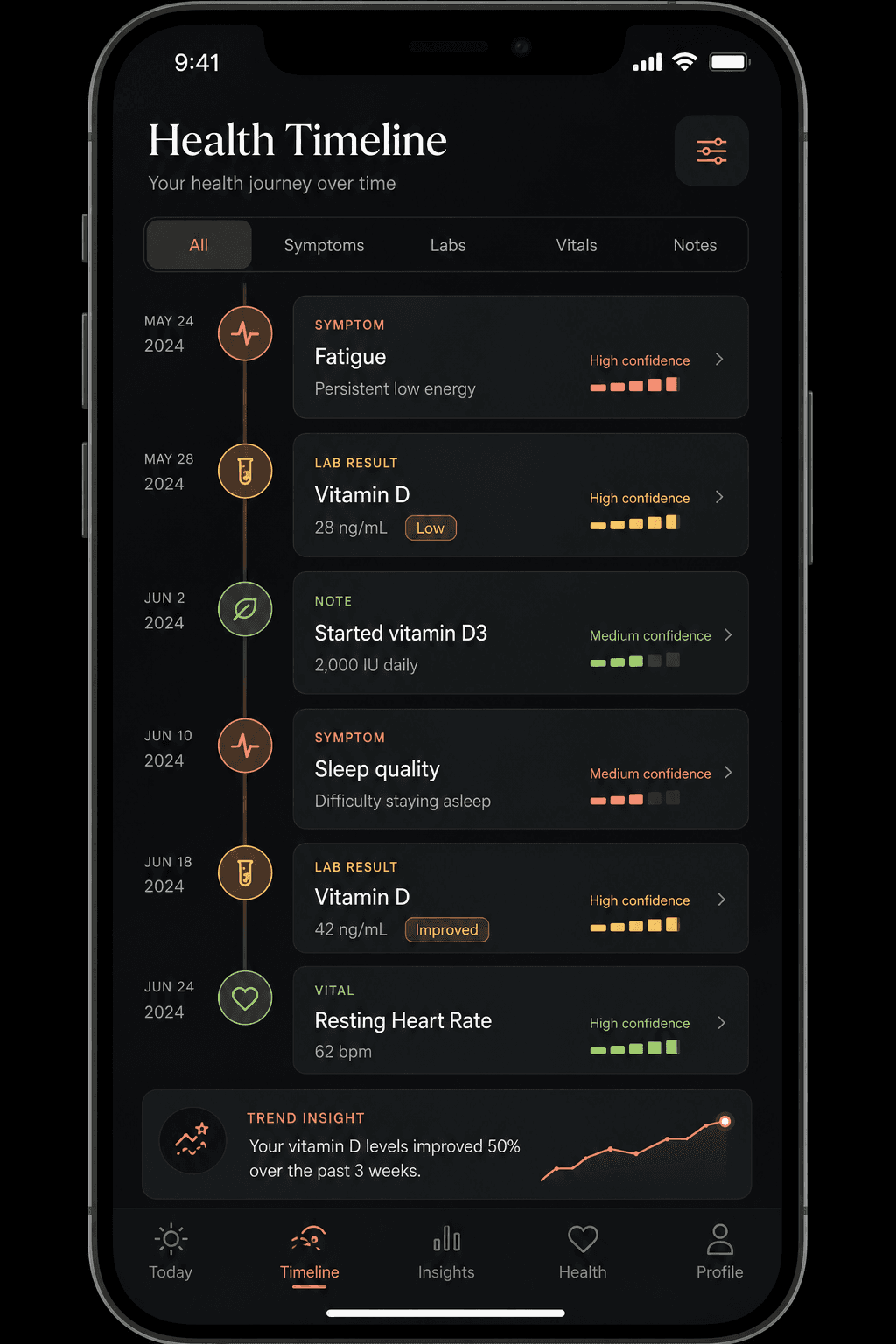
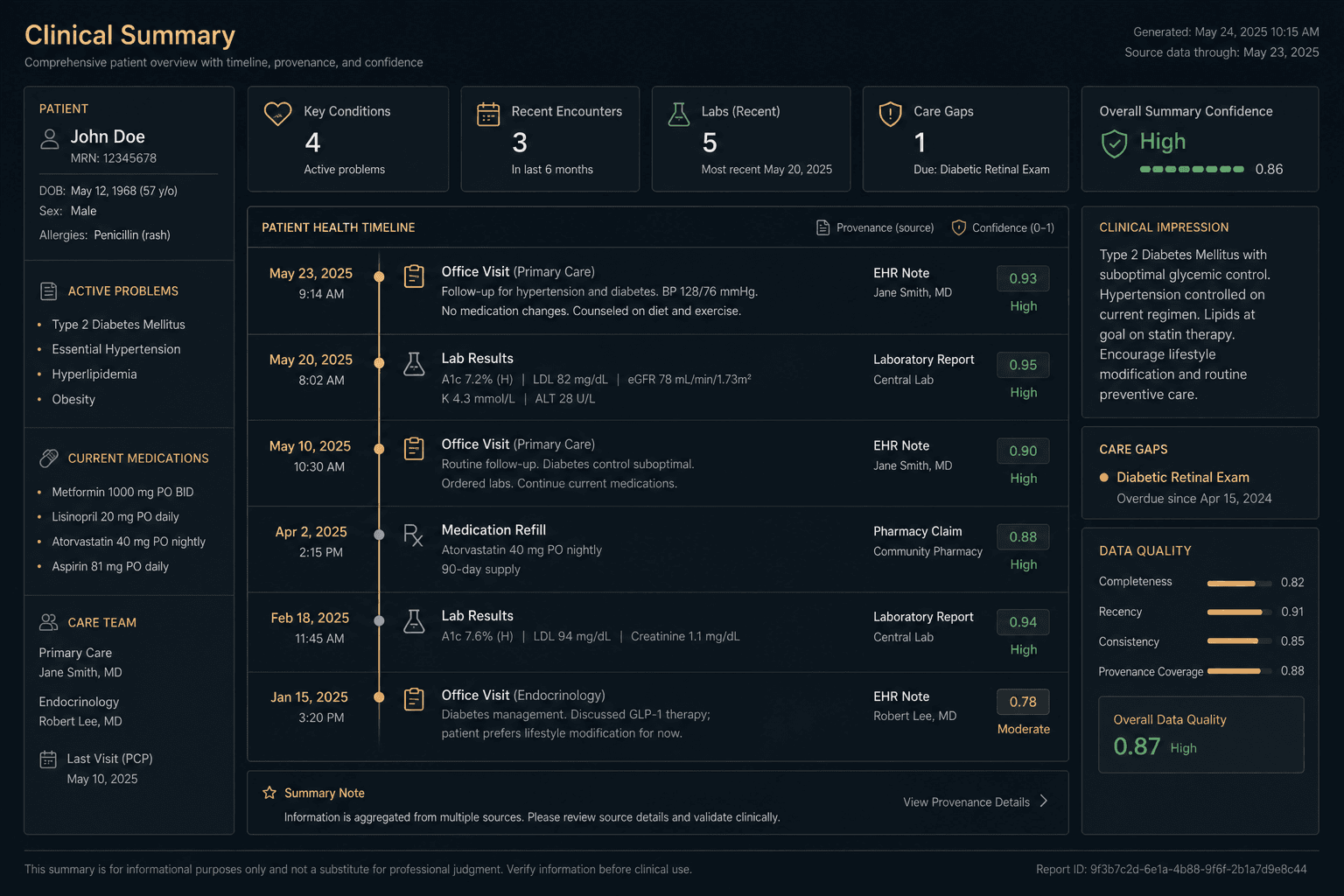
Specialist agents should share context, not create more silos.
Health Core is designed so agents can be narrow, accountable, and useful without each maintaining a separate version of the person.
One shared Longitudinal Health Profile. Many specialist agents, each connected to the same context.
Domain agents
Sleep, recovery, symptom, medication, clinical prep, and experiment agents operate over the same profile.
Permissioned writes
Agents declare what they can read, what they can write, and which actions require explicit approval.
Shared context
Contradictions and low-confidence interpretations remain visible because agents do not maintain private versions of the person.
Early agent domains under exploration:
- Sleep
- Recovery
- Symptoms
- Medication
- Experiments
- Clinical prep
Choose how you want to start.
Use Health Core for yourself, or build agents on the shared profile.
The non-negotiables we build to.
These are engineering constraints, not slogans — the properties without which longitudinal health infrastructure cannot be trusted.
Recommendations are calibrated to your history — not a population average that bears no resemblance to you.
One consistent model of the person. Agents do not contradict each other without explanation.
Unresolved threads and follow-ups are preserved. A longitudinal agent is not a stateless chatbot.
You stay in control of your own model — more capable and informed, not more dependent on the platform.
What we will not compromise.
- Agents stay narrow and accountable, never generic bots
- Uncertainty is preserved, never flattened into false certainty
- Composition is modular, so the system can be inspected and extended
- The person owns the model, with provenance at every layer
Agency is concrete. Over any meaningful part of your profile, you can:
- Inspect
- Correct
- Approve
- Export
- Restrict
- Delete
Developer alignment matters in health infrastructure.
Health Core is being shaped as open-core infrastructure so the primitives can be inspected, extended, and trusted by serious builders, not hidden behind a closed wellness app.
Developer model →Early, serious, and deliberately scoped.
QED is building the foundations first: schema, profile, permissions, provenance, and the first agent surfaces. The work is intentionally narrow before it becomes expansive.
Health Core schema and ingestion primitives
The Longitudinal Health Profile interface
Consent, export, correction, and provenance flows
Early modular agents for personal context and care preparation
Follow or collaborate on the foundations.
We're speaking with early users, clinicians, researchers, developers, and partners who care about longitudinal context, data continuity, and safer health agents.
- Your health model belongs to you — inspect, correct, export, or delete it.
- Provenance and uncertainty are visible, never buried.
- Not a diagnostic or treatment system.